


Tempo raises $31M to commercialize its energy storage ‘booster’
News
Tempo raises $31M to commercialize its energy storage ‘booster’
The startup says its novel thermochemical storage system is a cost-effective way to provide clean heat to fossil fuel–reliant heavy industries.
Many of the world’s hardest-to-decarbonize industries face a similar challenge: how to obtain the white-hot heat their operations need — without using fossil fuels.
Redoxblox, a San Diego-based startup that landed $31 million in venture investment on Wednesday, says it has found a clever way to achieve this task: using the power of chemical reactions to store energy at 1,500 degrees Celsius for hours at a time.
That’s one way to describe the electrochemical storage breakthrough that Redoxblox has been working on commercializing for the past four years. At its heart is a proprietary metal oxide developed by company co-founder James Klausner that’s capable of undergoing a reversible redox cycle — a chemical reaction that can discharge a blast of energy.
The firm is still in the early stages compared with some of its thermal storage competitors, but aims to eventually help industries from food processing to chemical and cement production clean up their heating.
Industry accounts for roughly 30 percent of global carbon emissions, said CEO Pasquale Romano — and most of those emissions come from fossil-fueled high-heat processes. The industrial sector remains well behind in its effort to decarbonize as rapidly as is needed to combat climate change.
Ever-cheaper renewable energy — the main tool for decarbonizing sectors like electricity, transportation, and building heating — is making thermal energy storage solutions like Redoxblox’s more economically viable as replacements for fossil-fueled industrial heating. But these technologies still have to prove themselves capable of doing the job.
The science behind Redoxblox’s “booster storage”
Redox, or reduction-oxidation, reactions are the driving force behind energy storage technologies such as redox flow batteries. But unlike other redox-based batteries — and standard lithium-ion batteries — Redoxblox’s systems don’t store electrical energy in electrochemical bonds.
Neither do Redoxblox systems store heat only, as is the approach of its thermal storage competitors like Antora Energy, Brenmiller Energy, Calectra, Rondo Energy, and others that have received hundreds of millions of dollars of investment over the past decade or so.
Instead, Redoxblox passes electricity through its storage material, contained inside steel pressure vessels, Romano said. “The current passing through the storage material heats it up, because the storage material is effectively a resistor,” he said — that is, it heats up much like the coils on an electric stove do.
Some heat batteries use resistive heating materials like these, while others use materials like rocks and bricks to absorb heat delivered via separate resistive heating elements. In both cases, heat is what’s being stored, rather than electricity.
Redoxblox’s process differs by using a redox reaction to squeeze more heat out of its thermal storage system than would be possible otherwise. Romano called it a “booster” for energy storage.
When the startup’s proprietary metal oxide reaches temperatures between 1,000 and 1,500 degrees Celsius, “the redox reaction starts,” Romano said. That reaction involves the chemical separation of oxygen within the metal oxides, “and when that oxygen breaks off, the chemical process is endothermic — it’s absorbing heat that’s caused by the electrical current,” he said.
In essence, that high-temperature chemical reaction increases the energy stored within the system above and beyond the heat that’s contained within the storage medium, which in Redoxblox’s case is its proprietary metal oxide.
But dispatching that additional energy requires reversing the redox cycle. To do so, Redoxblox blows air through the storage material. The oxygen in that air is “causing the redox reaction to go in the opposite direction,” Romano said — and that reaction is exothermic, or heat releasing. That provides an extra energy boost to what would otherwise be an unadulterated transfer of heat from the storage medium to the air blowing through it.
“It’s holding up the temperature higher than if you were blowing air across it and using the heat only,” he said. “That means in an industrial application that needs super-hot air, we spend a lot more time hanging out in the 1,500 to 1,200 [degrees Celsius] zone before you have to charge it up again.”
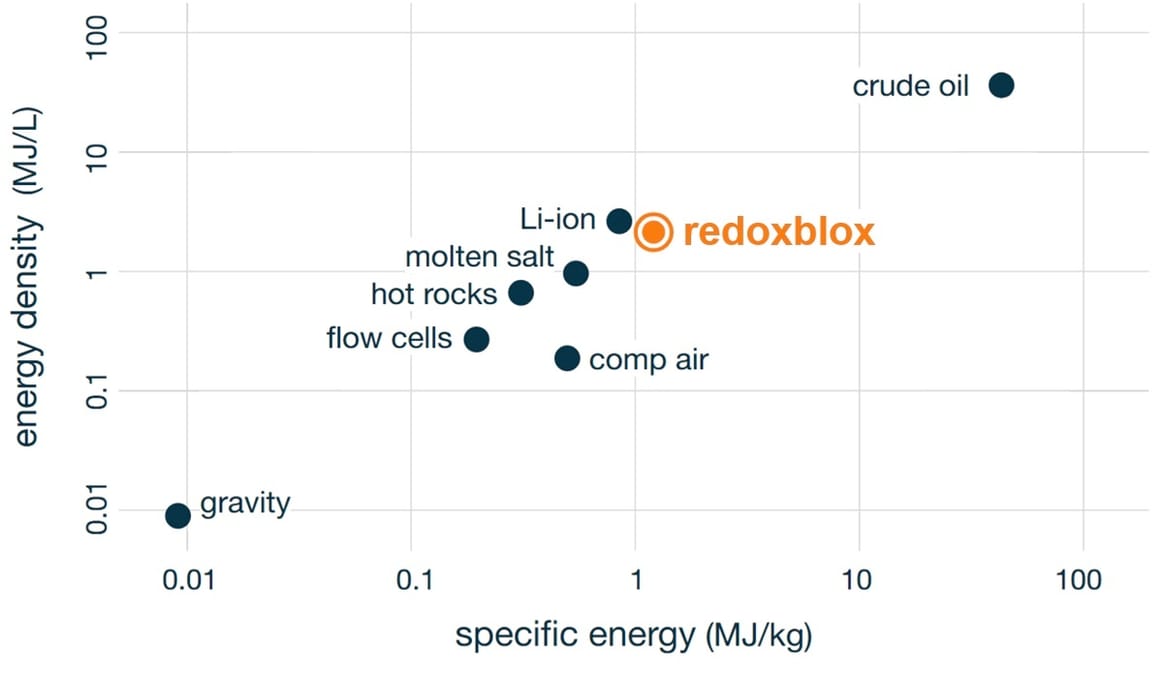
That extra energy boost pumps up the “energy density” of the Redoxblox system compared with heat-only thermal energy storage systems, as the chart below indicates. It also puts its technology on a close-to-equal footing with the energy density of lithium-ion batteries — although the company claims that it can pack more energy into a smaller area and at a lower cost than lithium-ion batteries.
These characteristics make Redoxblox suitable for a wide range of industrial applications, Romano said. At its hottest, the air coming out of its systems can feed high-temperature processes such as cement calciners and furnaces. Or it can be mixed with cooler air to run drying ovens, steam boilers, and other lower-heat needs.
It can also be used to generate electricity, Romano noted. In 2019 the company won a $2.1 million grant from the Department of Energy’s Advanced Research Projects Agency-Energy, where Klausner was then working as a program director. That grant funded work on integrating the Redoxblox storage system with a gas turbine engine that can run on the superheated air from the storage vessel rather than on fossil gas.
Redoxblox has been testing smaller-scale systems in pilot projects. In June 2023 the company won a $6.7 million DOE grant to fund work with the Electric Power Research Institute and chemicals giant Dow to install a 10 megawatt-hour system at a chemical plant in West Virginia that will convert electricity into high-heat industrial steam.
And earlier this year the California Energy Commission approved an $8.9 million grant for a 3-megawatt-hour system at the University of California, San Diego that will provide up to 24 hours of energy storage capacity to power a turbine to generate electricity.
The $31 million raised by Redoxblox this week will help finance the next steps in the company’s commercialization efforts, said Romano, who was named CEO earlier this year after stepping down from the helm of EV-charging company ChargePoint. The new round was led by Prelude Ventures and joined by Imperative Ventures and New System Ventures, alongside previous investors Breakthrough Energy Ventures and Khosla Ventures, which both invested $9.4 million in the company in January.
Redoxblox holds multiple patents on the proprietary metal oxide used in its reversible redox cycle process, Romano said. The company was founded in 2020 by Klausner and Jörg Petrasch, both professors at Michigan State University. Klausner discovered the metal oxide material in 2018 while at the University of Florida, and then brought his team to MSU for continued development.
While the company is tight-lipped on the composition of its metal oxide, Romano said it’s derived from common metals that contain “nothing bad and nothing that comes from bad places.” The company states its materials are “stable, long-lasting, non-toxic, non-flammable, and recyclable.”
Redoxblox also hasn’t revealed key details about its planned commercial product, such as costs per unit of energy storage. But the company has said that it plans to deploy systems that fit into a 40-foot container and can store up to 20 megawatt-hours apiece, with a 95 percent round-trip efficiency in terms of the conversion of electricity to thermal energy, which is comparable to advanced lithium-ion batteries.
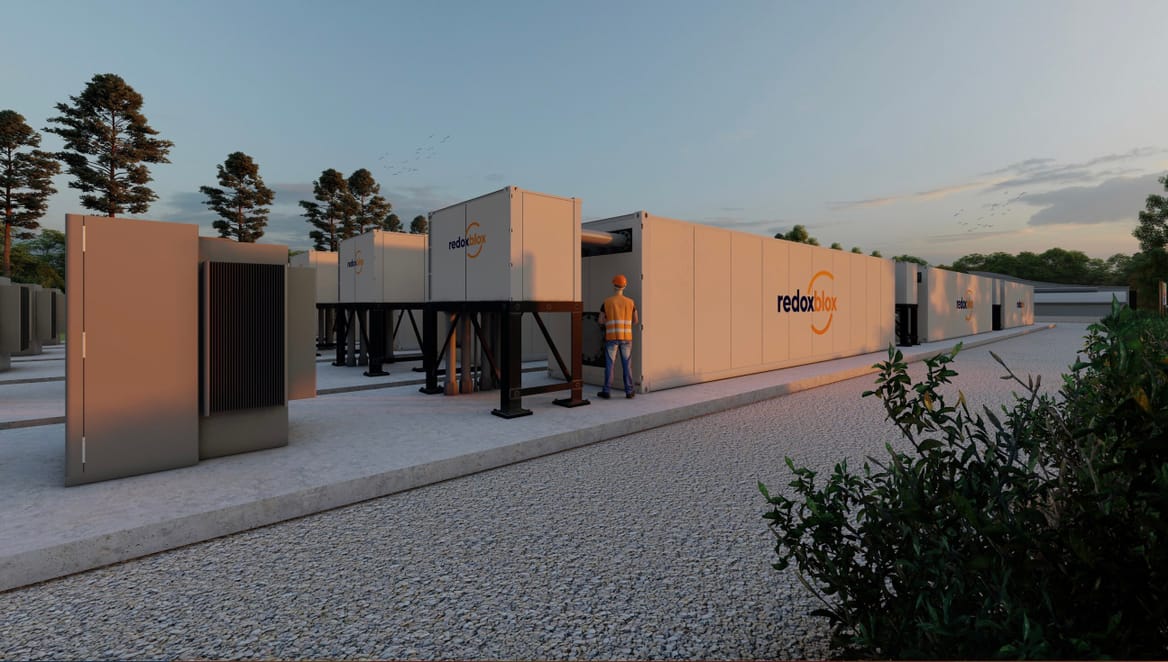
Romano described a typical commercial installation that could consist of multiple individual units to match the hundreds of megawatt-hours of stored heat that most industrial sites will need. The company will likely rely on contract manufacturers for much of its system and process and assemble them close to the source of the minerals that go into its metal oxide, he said.
Redoxblox has yet to set a timeline for bringing its systems to commercial scale. “But it’s not like new lithium-ion battery technologies that take decades and decades to mature,” Romano noted. “There’s been enough primary research done when our founders were back at their university jobs.”
octubre 30, 2024
Tempo Closes $40.7 Million Series A to Support Industrial Decarbonization and Grid Storage with Next-Gen Thermochemical Energy Storage System

Press Releases
Tempo Closes $40.7 Million Series A to Support Industrial Decarbonization and Grid Storage with Next-Gen Thermochemical Energy Storage System

Redoxblox raised an additional $30M in Series A funding, led by Prelude Ventures and joined by Imperative Ventures and New System Ventures, alongside existing investors Breakthrough Energy Ventures and Khosla Ventures. This brings the total Series A round to $40.7M.
octubre 30, 2024
San Diego, CA
Arrabawn Partners with Tempo, Climeaction, and VIOTAS to Launch Groundbreaking Heat Battery Technology in Ireland
News
Arrabawn Partners with Tempo, Climeaction, and VIOTAS to Launch Groundbreaking Heat Battery Technology in Ireland

 English
  Spanish
  German